



Why does canned food legally need twice the taurine of dry?
AAFCO Cat Food Nutrient Profile, dry matter basis
Same standard. Same cat. Same amino acid.
It’s the same animal with the same requirement, so the difference isn’t in the cat — it’s in what happens to taurine on the way through. You don’t have to take our word for it. The profile is published, and it takes about five minutes to check.
Complete and balanced describes the bag. Not the bloodstream.
In 1987, a team at UC Davis found that dilated cardiomyopathy in cats was linked to low taurine, and that supplementing it restored heart function. The industry reformulated. The disease went from common to rare. Everyone agreed the problem was solved.
The same researchers kept working. A few years later they tracked labelled taurine through cats on two different diets and found that heat-processed food caused substantially greater taurine losses through the gut than a fresh, frozen-preserved diet.
That finding is over thirty years old and publicly available. It has never appeared on a bag of cat food. The industry’s fix was to put more taurine in the bag — nobody addressed what happens to it afterwards.
Your cat isn’t being underfed taurine. She may simply be collecting less of it than the label suggests. And the label has no way to tell you the difference.
Pion, Kittleson, Rogers & Morris, Science 237:764–768 (1987). Kim, Morris & Rogers, Journal of Nutrition — effect of processing on the fate of dietary taurine in cats. AAFCO Cat Food Nutrient Profile. We link all three. Check them.

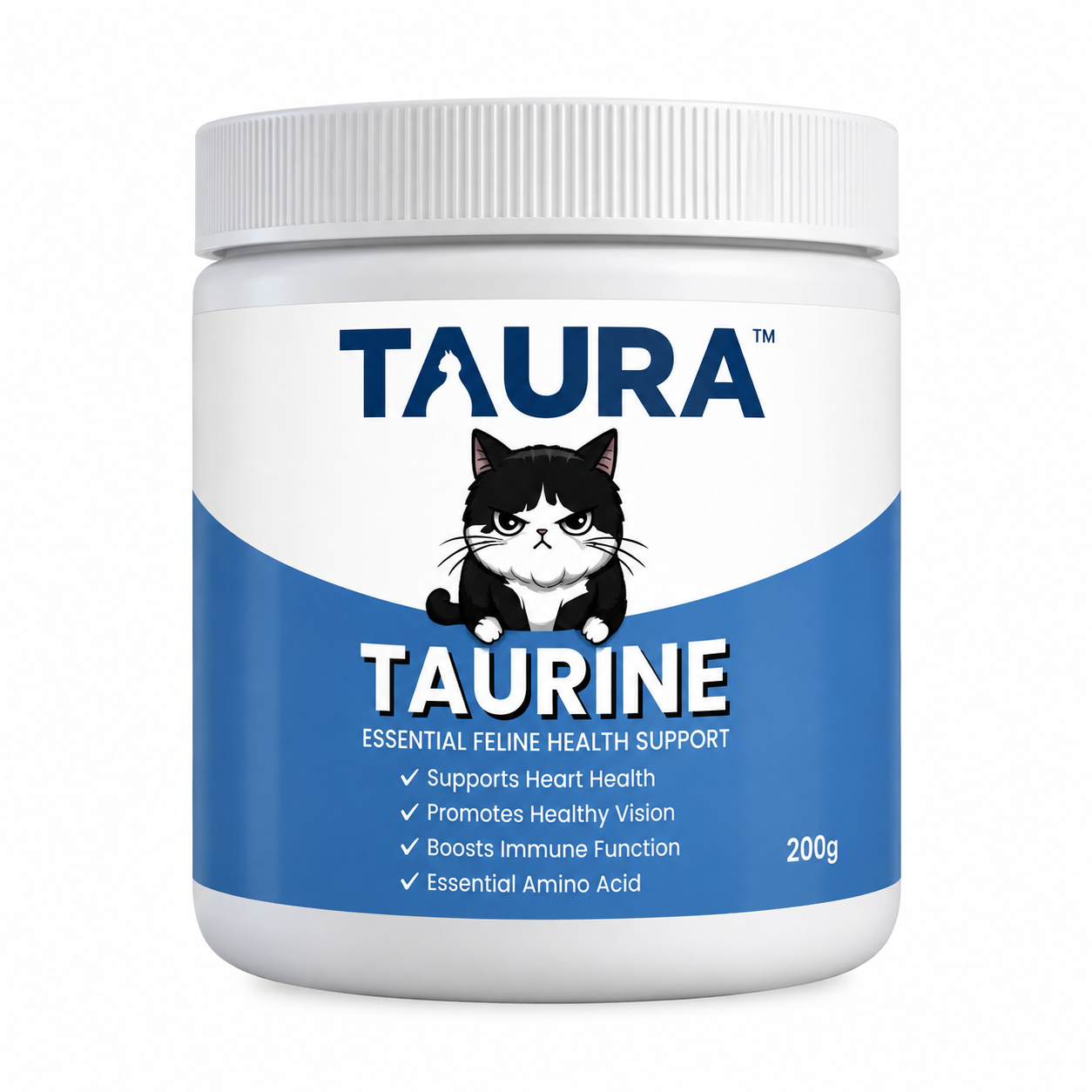
Turn the tub over. That’s the whole review.
Most cat taurine supplements are not mostly taurine. It isn’t that the fillers are dangerous — it’s that you came here to buy taurine, and a bulking agent is cheaper than the thing you’re paying for.
- Maltodextrin
- Taurine
- Silicon dioxide (anti-caking agent)
- Natural flavour
Taurine is the second ingredient. You buy it by volume and receive it by fraction.
- Taurine (99%+)
That’s the entire panel. No maltodextrin, no anti-caking agent, no flavour carrier, no bulking agent. Certificate of analysis published for every batch.
FAQs
I've tried everything. Why would this be different?
Honestly — it might not be. What's different is narrower: this targets flat post-acne marks specifically rather than "brightness" generally, it's one cream step instead of a stack, and we've published the formula, origin and a realistic timeline so you can judge it instead of hoping. If that's not enough of a difference for you, that's a reasonable call.
How long until I see something?
Evaluate over 8–12 weeks of consistent daily use with sunscreen. Anyone promising 2–4 weeks on flat post-acne marks is selling you a timeline, not a result.
I have sensitive skin — and 7% sounds strong.
A percentage on its own doesn't tell you about tolerability — the formula, the vehicle and your skin decide that. We can't promise sensitive-skin suitability, because we don't have a sensitive-use study on this cream and we're not going to claim one. Read the full ingredient list, patch test for three days, start every second night, and stop if it irritates you.
Is tranexamic acid an exfoliating acid?
No. It's not an AHA or BHA. It doesn't exfoliate, peel or resurface — the "acid" in the name is chemistry, not action.
Can I use it with retinol or vitamin C?
Generally people layer tone-care creams with both, but conservatively: introduce one change at a time, alternate nights if you're new to retinoids, and simplify immediately if you get stinging or flaking. If you're on prescription treatment, ask your prescriber.